


 English
 русский
 Español
 Português
 italiano

Home / News / Industry News / HV Series Corn Header Gearboxes vs. Cycloidal Reducers in Combine Harvesters


Industry News
Nov 02,2026
HV Series Corn Header Gearboxes vs. Cycloidal Reducers in Combine Harvesters
Corn headers are unforgiving drivetrains. Snapping rolls must turn slowly while carrying high torque, gathering chains must stay synchronized on both sides, the cross auger has to move a heavy mat of stalks, and any of these functions can seize within a second when a foreign object or a wet patch of crop arrives. Two transmission families dominate this zone: the HV series corn header gearbox, a gear-pair unit built around the geometry of the header frame, and the cycloidal reducer, a compact high-ratio unit borrowed from conveyors, elevators and other slow-turning machinery.
Discussions about the two often assume one could simply replace the other. In practice they solve different problems, and the decision usually comes down to how much ratio is needed, how much shock the drive must swallow, and how much space the header frame leaves for the housing.
Short version: gear pairs win on efficiency, backlash control and speed regulation; cycloidal stages win on ratio density, axial compactness and tolerance to jams and reversing loads.
Gearbox or Cycloidal Reducer: The Core Difference
Both devices reduce speed and multiply torque, but they do it through completely different contact mechanics, and that difference shapes everything downstream.
How a gear-pair header gearbox works
In a corn header gearbox, power passes through meshing teeth. A bevel or spiral bevel pair turns the drive through 90 degrees to reach the snapping rolls or the auger, while spur or helical pairs handle parallel shafts and the chain drives. The ratio comes from tooth counts, so a single pair typically delivers something between 1:1 and about 1:5, and two pairs are stacked when more reduction is required. Each mesh is highly efficient, backlash can be held to a small and repeatable value, and the whole unit runs in an oil bath inside a cast iron or aluminum housing.
How a cycloidal reducer works
A cycloidal reducer uses an eccentric bearing to push a lobed disc around a ring of pins. The disc rolls rather than slides, and the ratio is set by the number of lobes, so a single stage commonly covers roughly 1:11 to 1:87, with two stages going far higher. Many teeth share the load at any moment, which gives excellent shock capacity and a very short axial envelope. The trade-offs are lower efficiency, a fixed amount of internal clearance, and a torque ripple that is harmless on an elevator but noticeable on a chain that must stay synchronized.
Inside the HV Series Corn Header Gearbox
The HV series is designed around the functions that actually sit on a corn header rather than around a generic ratio requirement. A typical unit such as the ND HV210 header gearbox for corn harvesters uses a cast iron housing with right-angle bevel gearing and multiple output positions, so snapping roll drives, gathering chain sprockets and the cross auger can be fed from one central housing on the header frame.
That concentration matters in the field. Fewer housings mean fewer seals, fewer oil levels to check and a shorter shaft layout, which reduces whip and misalignment on wide headers. Gear pairs also allow the designer to control the relative speed of the snapping rolls against the auger precisely, and to add a clutch, free wheel or variable pulley on the input side when the operator needs to match ground speed or crop condition.
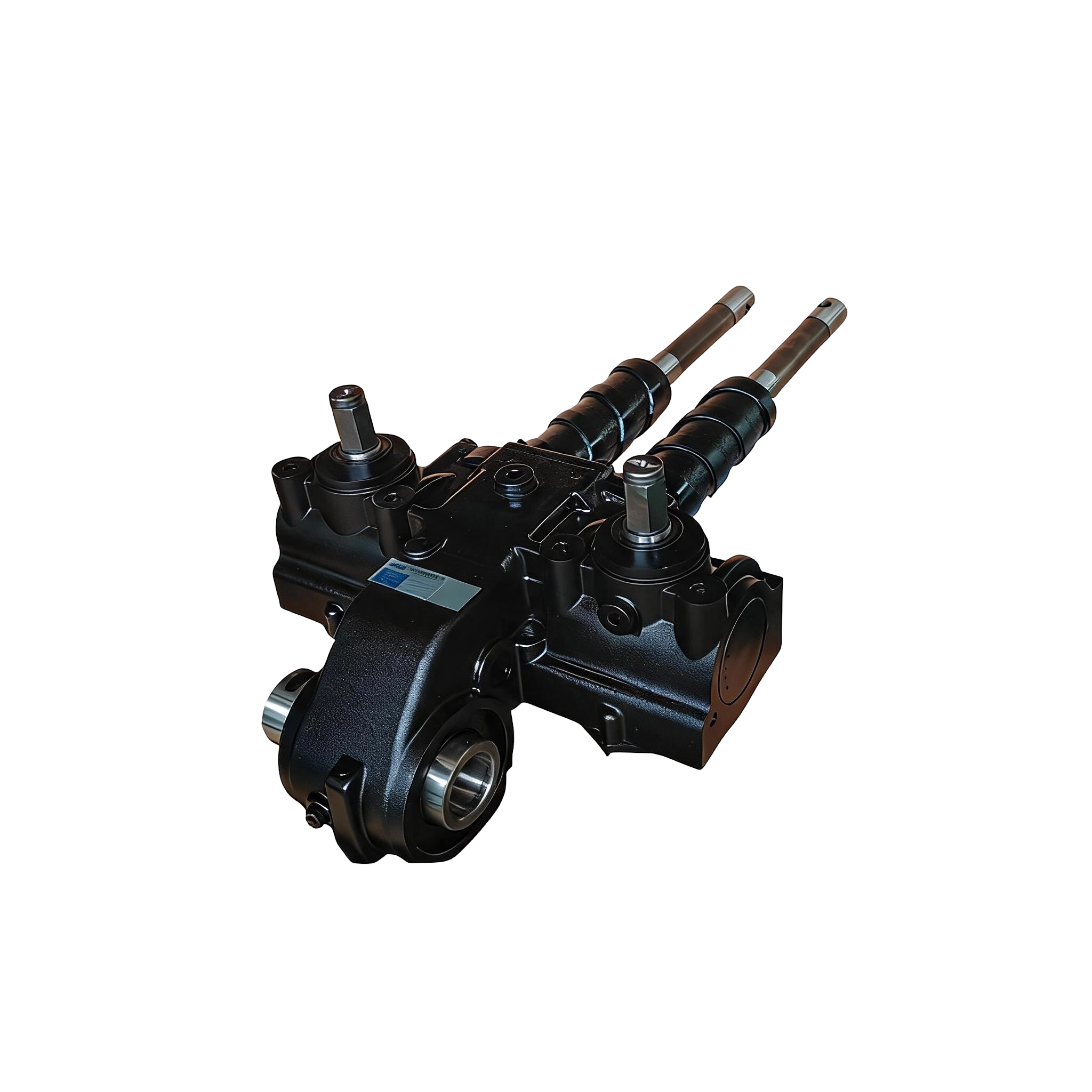 ND HV210 Header Gearbox for Corn HarvestersA corn header transmission unit with reinforced gearing, rigid housing and sealed lubrication, suited to driving snapping and stalk-cutting components under continuous impact.View Product →
Where the Cycloidal Reducer Belongs on a Combine
On the same machine, the cycloidal unit earns its place away from the header face. Grain elevators, unloading augers, tailings returns and clean grain cross conveyors all want a large reduction in a short axial length, often in a place where a two-stage gearbox would not fit. A unit such as the ND PL085 cycloidal gearbox for combine harvesters is typical of this role: coaxial, compact, and comfortable running at a few hundred rpm with a full load on the shaft.
Cycloidal stages also tolerate the abuse that comes with blockage. When an elevator plugs and the drive is reversed or bumped, the load spreads across many lobes instead of concentrating on one or two teeth. The penalty is lower efficiency and a slightly larger power draw at the same output torque, which is a minor cost on an intermittent conveyor and a major one on a continuously loaded header drive.
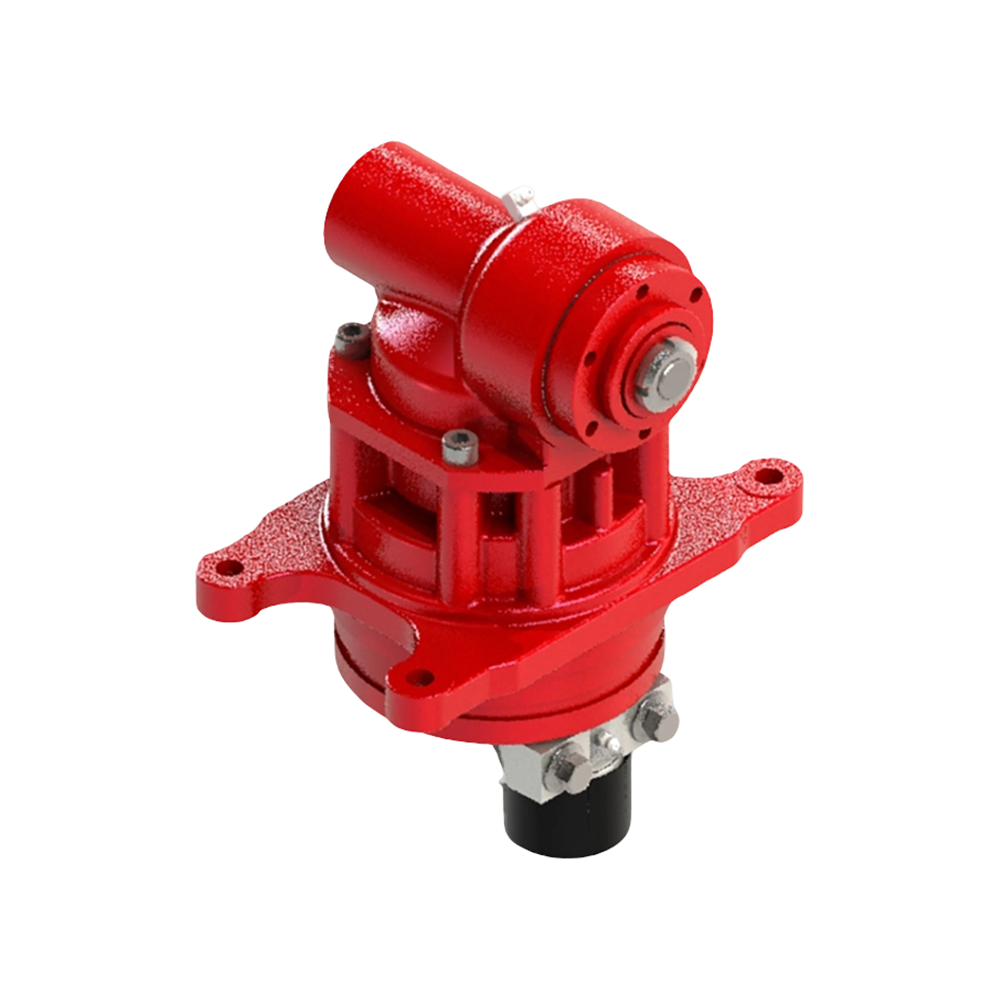 ND PL085 Cycloidal Gearbox for Combine HarvestersA compact cycloidal reduction unit for combine harvester feed, threshing and conveying drives, offering overload resistance and sealed protection in dusty field conditions.View Product →
Side-by-Side Comparison for Header and Combine Drives
The table below summarizes the practical differences when both options are evaluated for the same machine envelope.
| Criteria | HV series gearbox | Cycloidal reducer |
|---|---|---|
| Ratio per stage | About 1:1 to 1:5 per pair, stacked when needed | Roughly 1:11 to 1:87, higher with two stages |
| Efficiency | High, typically above 95 percent per mesh | Moderate, commonly 85 to 93 percent |
| Shock and jam tolerance | Set by tooth and bearing capacity, needs a clutch or slip device | Spread over many lobes, inherently robust |
| Backlash and synchronizing | Small and repeatable, suitable for timed chains | Fixed internal clearance, less ideal for timing |
| Envelope | Right-angle layout, larger footprint | Coaxial, very short axial length |
| Speed variation | Easy to combine with clutch or variable pulley | Needs a separate variator upstream |
| Typical use | Snapping rolls, gathering chains, cross auger | Elevators, unloading augers, slow conveyors |
HV Series Agricultural Corn Header GearboxA corn and combine harvester header gearbox series built for reinforced load handling, dust-resistant sealing and stable output, with OEM and aftermarket configuration options.View Product →Matching the Drive Type to the Header Function
Snapping rolls
These turn slowly, well below 1,000 rpm, and carry the highest continuous torque on the header. Gear pairs handle them well because a single bevel reduction plus a spur stage covers the range without excessive size, and the housing can carry roll bearings close to the load.
Gathering chains and cross auger
Both need timed rotation and modest backlash. A gear-pair layout keeps the two sides of the header in step and allows a shared housing with separate outputs, which is exactly the pattern the HV series follows.
Stalk choppers and high-speed shafts
Where the requirement is speed rather than reduction, a gearbox is usually chosen, often with an overrunning clutch so the chopper can spool down without back-driving the header.
Grain handling inside the machine
This is the natural home of the cycloidal reducer, where a large ratio, coaxial mounting and tolerance to blockage matter more than a point of efficiency.
Selection Checklist Before You Specify a Unit
- Calculate the continuous and peak torque for each output, not just the tractor or engine input.
- Confirm the required output speed range and how it will be varied, mechanically or hydraulically.
- Check the shock spectrum: stone strikes, plugging, reversing and cold-start loads.
- Verify the mounting interface, shaft centers and available envelope on the header frame.
- Decide whether synchronization or backlash control is a functional requirement.
- Confirm lubrication method, oil level access and service intervals in the field.
- Review seal protection against dust, chaff and pressure washing.
- Check that gears, shafts, bearings and seals are available as spares.
Service, Spares and Long-Term Support
Whichever layout is chosen, the header drive spends its life in dust and vibration, so support matters as much as the ratio. Replacement bevel gears, cylindrical gears, power transmission shafts and PTO shafts should be obtainable without changing the whole assembly. For machines working across several crops, it is worth reviewing the wider harvest and material handling solutions to check that the header drive, feederhouse and elevator ratios are coordinated rather than optimized one at a time.
If you are specifying a drive for a new header or replacing a unit that keeps failing, you can discuss your header drive requirements with the engineering team and confirm the ratio, mounting pattern and output arrangement before ordering.
Frequently Asked Questions
Q1: Can a cycloidal reducer replace a corn header gearbox directly?
Rarely on a one-to-one basis. The cycloidal unit is coaxial and lacks the right-angle output and multi-shaft layout that a header needs, so it usually appears as a supplementary drive rather than a substitute.
Q2: Which unit copes better with a snapping roll jam?
The cycloidal stage distributes shock across many lobes and generally absorbs abuse more gracefully, but a gearbox paired with a slip clutch or shear protection remains the practical choice for header rolls.
Q3: Is efficiency really a deciding factor?
On a continuously loaded snapping roll drive, yes. A few percentage points of loss become heat and fuel over a long harvest day, while on an intermittent elevator the difference is negligible.
Q4: How do lubrication needs differ?
Gearboxes run in an oil bath with defined oil levels and change intervals, while cycloidal units often use grease or a sealed oil charge and require less frequent attention.
Related Products

-
 +86 18058161630
-
 +86 571 81607235
-
 sales@ag-mech.cominfo@ag-mech.comiris@ag-mech.com
-
 No.21 Feixiang Rd, Suoqian Town,Xiaoshan Dist. Hangzhou, Zhejiang Province, China

Products

Contact Us
Copyright ©
Hangzhou Hengnie Machinery Co., Ltd.
All Rights Reserved. Wholesale Agriculture Speed Reducers Supplier Custom Agricultural Gearboxes Manufacturer

