


 English
 русский
 Español
 Português
 italiano

Home / News / Industry News / HR Series Rotary Rake Gearboxes: Multi-Output Shaft Configurations Explained


Industry News
Nov 16,2026
HR Series Rotary Rake Gearboxes: Multi-Output Shaft Configurations Explained
A rotary rake is built around one simple demand: a single tractor PTO shaft has to spin a whole row of tine rotors at matched speed and matched phase. The part that makes this possible is the rake gearbox, and in the HR series it is built as a one-input, multi-output transmission, with one input shaft feeding anywhere from six to fifteen output shafts. Each output shaft carries a rotor hub, an arm carrier or a tine group, depending on the rake design.
The output count is not cosmetic. It sets how wide the rake can work, how the housing is machined, how torque is divided between rotors, and how the tine arms are timed so neighbouring tine paths never interfere. This article explains how a 1-to-6, 1-to-9 or 1-to-15 configuration actually works inside the housing, what changes as the count rises, and how to match a configuration to a specific rake design.
What the HR Series Gearbox Does on a Rotary Rake
On a PTO-driven rake, the tractor delivers rotary power at 540 or 1000 rpm. The gearbox performs three jobs at the same time: it turns the drive line through 90 degrees from the PTO shaft to the horizontal rotor line, it sets the ratio between PTO speed and tine speed, and it distributes that power to several output shafts that must all run at the same speed.
- Input stage: a splined or keyed input shaft sits in the front of the housing and connects to the tractor PTO through a shaft fitted with a slip clutch or shear bolt.
- Turn and ratio stage: a bevel pinion drives a bevel or crown gear, changing direction and adjusting speed before distribution.
- Distribution stage: a cross shaft carries power along the housing, and gear pairs pick off drive at fixed intervals.
- Output stage: splined or keyed output shafts protrude from the housing, each one supporting a rotor hub or arm carrier.
- Structural role: on many rake designs the housing also acts as a mounting beam, so it carries tine loads and ground-contact shock in addition to torque.
Inside a 1-Input, Multi-Output Configuration
The input stage
The input shaft turns in a bearing pair, usually tapered roller or deep groove ball bearings, and carries the bevel pinion. That pinion meshes with a bevel gear mounted on the cross shaft. This first mesh absorbs the direction change and most of the ratio change, which is why the input bearing housing is the most heavily reinforced area of the casting.
The distribution stage
A horizontal cross shaft runs the length of the housing, supported at intervals by bearing stations machined into the casting. At each station a gear pair, either spur or bevel depending on output orientation, takes power off the cross shaft and passes it to an output shaft. The bearing bores for the whole row are normally machined in one setup, because centre distances control backlash and tooth contact, and any misalignment shows up as noise and uneven wear.
The output stage
Each output shaft has its own bearing pair and lip seal so the oil bath stays inside the housing at every exit point. Shaft ends are splined or keyed, often with a retaining groove or circlip, and carry orientation marks used to phase the arms correctly. On longer housings, additional intermediate supports keep the cross shaft from flexing under load.
Design rule of thumb: every extra output adds one bearing pair, one seal and one gear set to the lubricated volume, so the housing grows faster than the output count suggests. That is why a 1-to-6 unit and a 1-to-15 unit look like different machines rather than the same machine stretched a little.
What Changes as Outputs Rise from 6 to 15
The torque per output shaft falls as the count rises, since total PTO power is shared more widely. What rises is length, weight, oil volume and sensitivity to shaft deflection, and the phase tolerance becomes tighter because more tine paths are packed into the same working width.
| Configuration type | Output shafts | Housing character | Typical rake format |
|---|---|---|---|
| 1 input, 6 outputs | 6 | Short cast housing, single distribution row | Compact single-rotor rakes, orchard and narrow working widths |
| 1 input, 8 outputs | 8 | Slightly extended row | Small two-rotor rakes with modest transport width |
| 1 input, 9 outputs | 9 | Extended row with additional support | Mid-width hay rakes |
| 1 input, 11 outputs | 11 | Long row, extra bearing stations | Wide single or twin rotor rakes |
| 1 input, 13 outputs | 13 | Long row, reinforced mid-section | Wide twin-rotor hay rakes |
| 1 input, 15 outputs | 15 | Longest housing, maximum bearing support | High-capacity rakes for large hay and straw operations |
Two examples show how far the range stretches. A compact six-output unit suits a small rake where transport width matters more than capacity, while a fifteen-output unit is a long, heavily supported casting intended to keep deflection low across a wide working width.
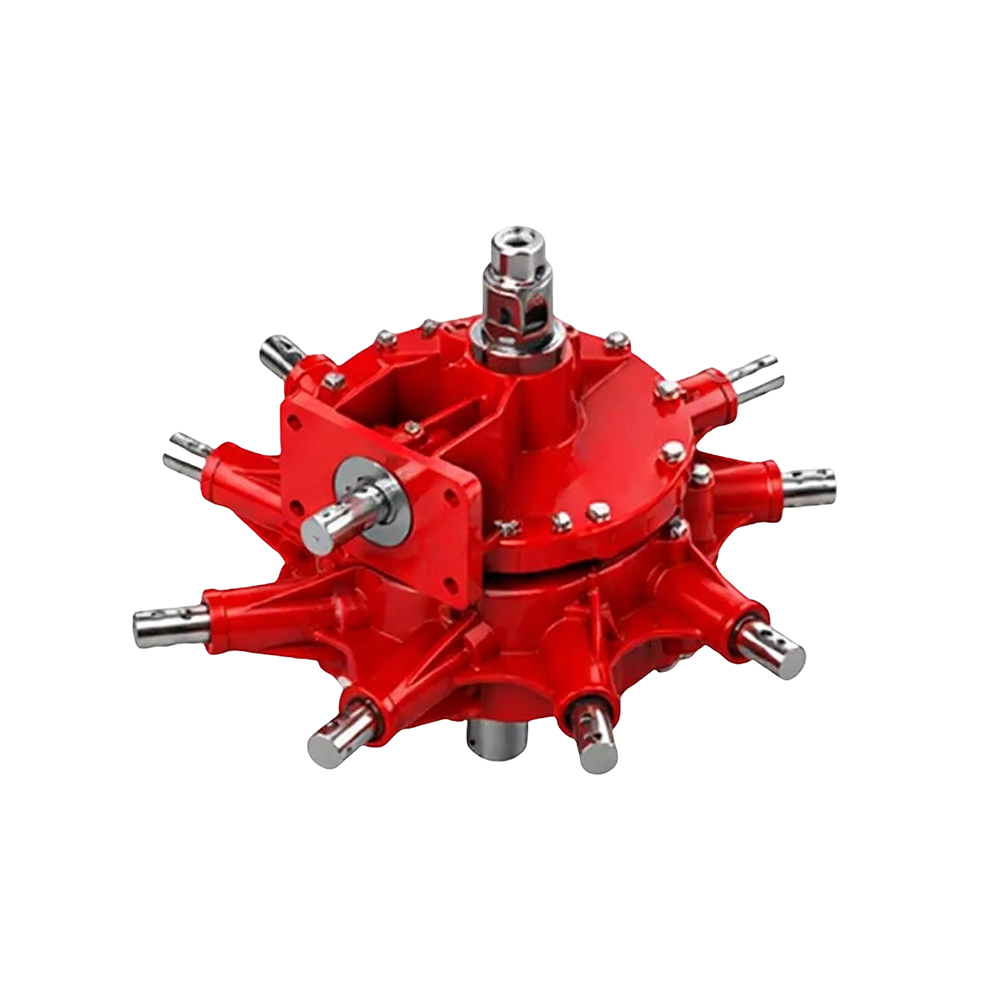
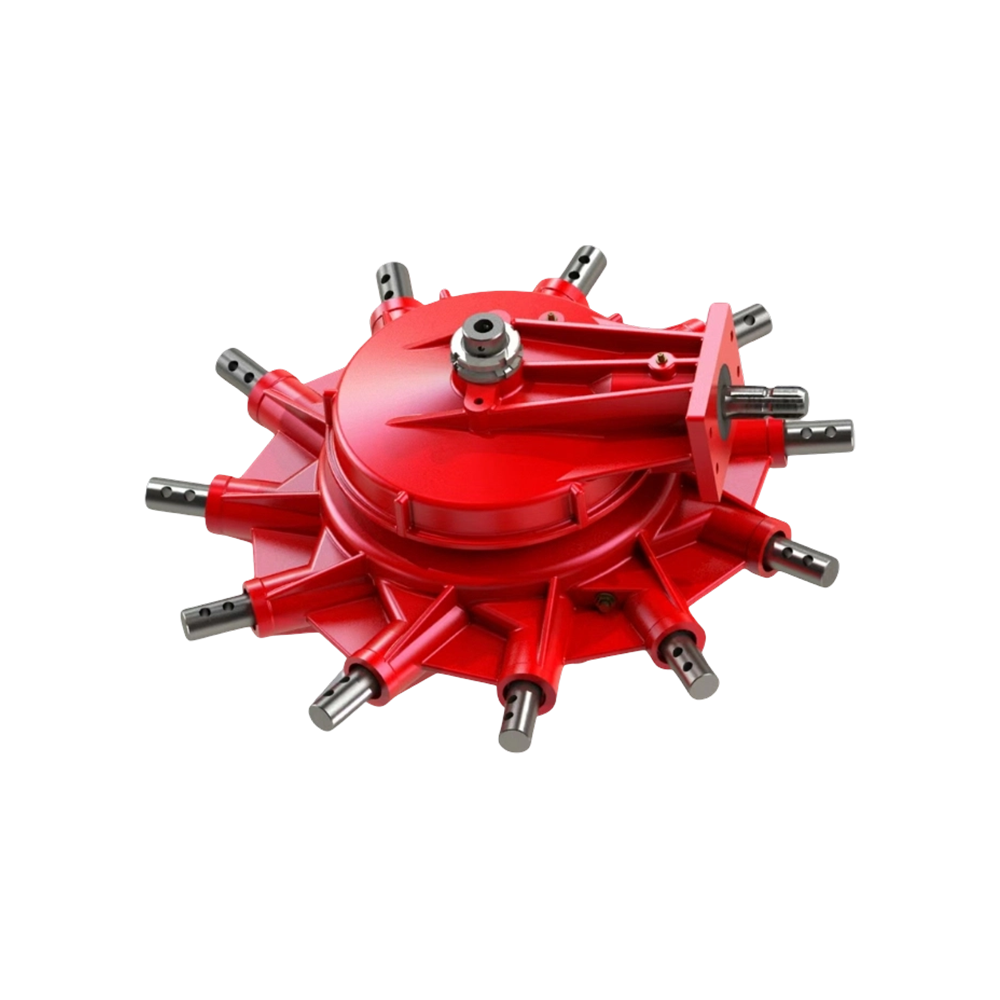
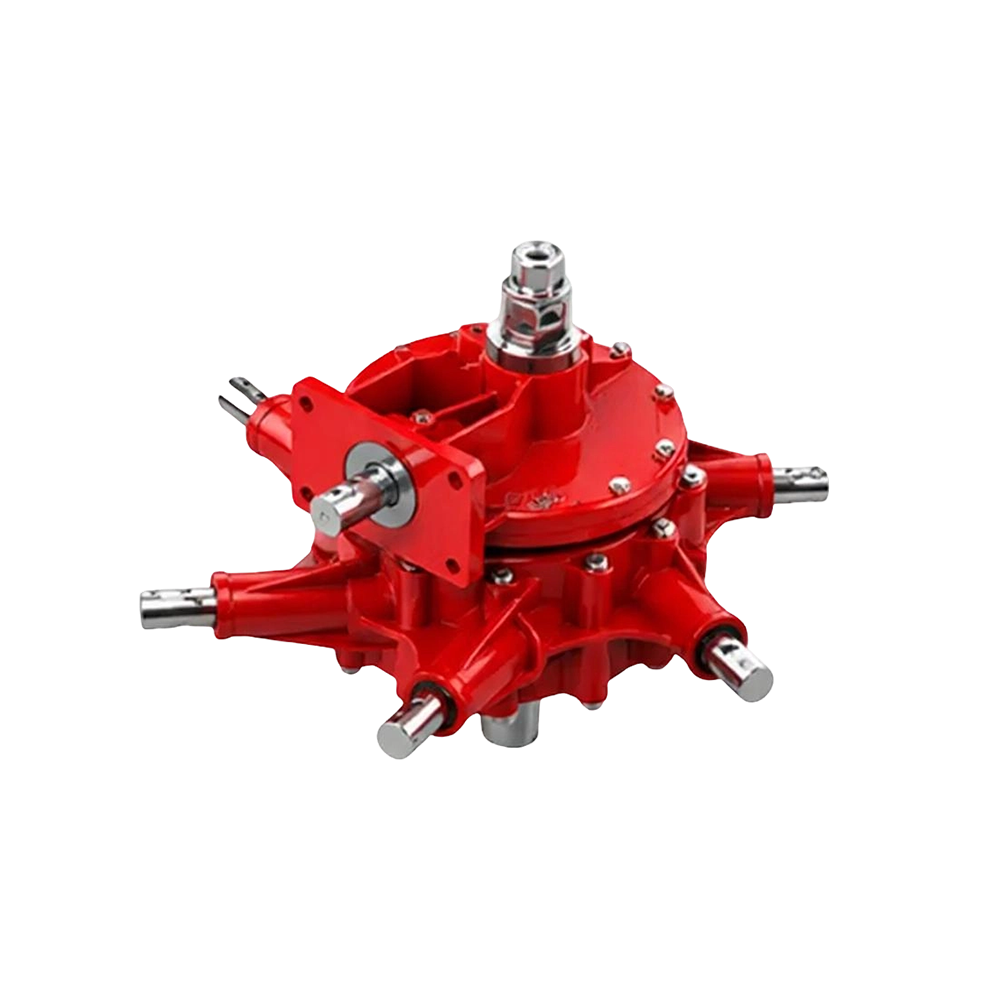 ND HR407 Six-Output Rotary Rake GearboxDedicated six-output transmission for medium hay rakes, distributing power synchronously to six raking components with a reinforced cast housing and balanced lubrication.View Product →
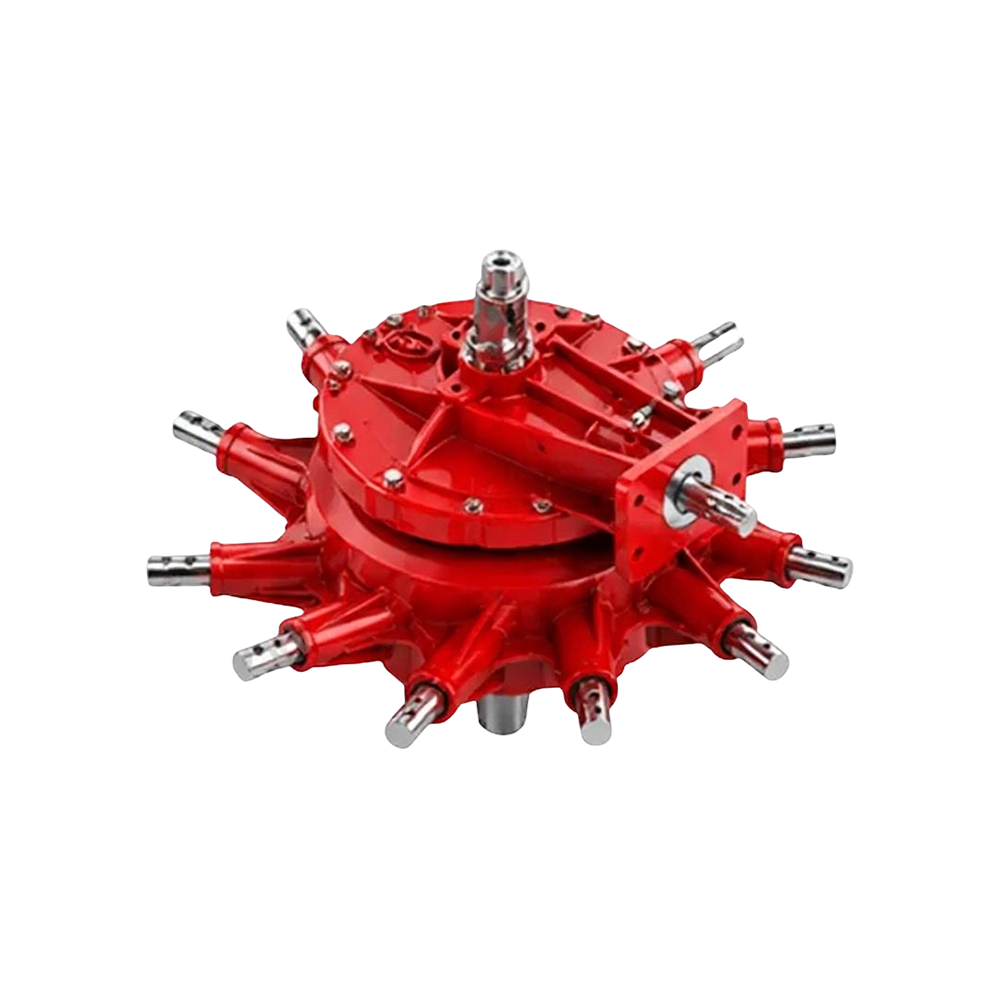
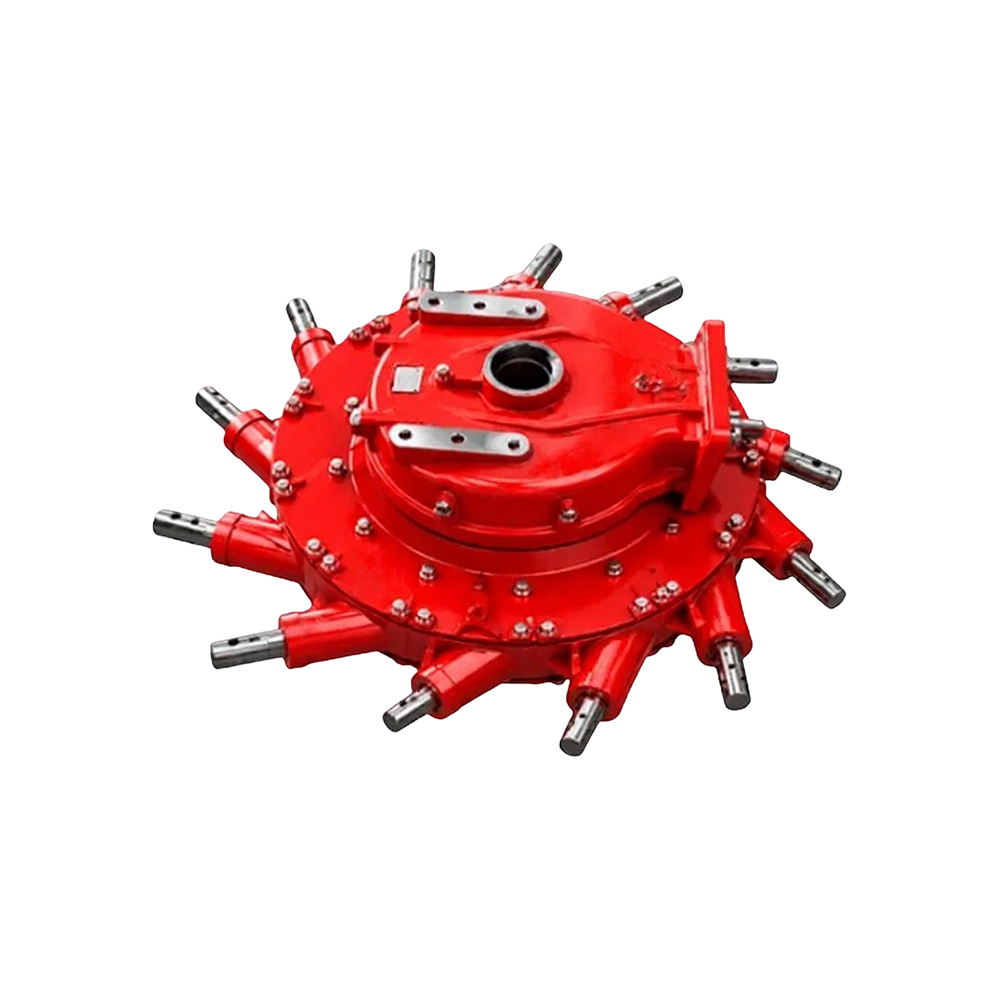
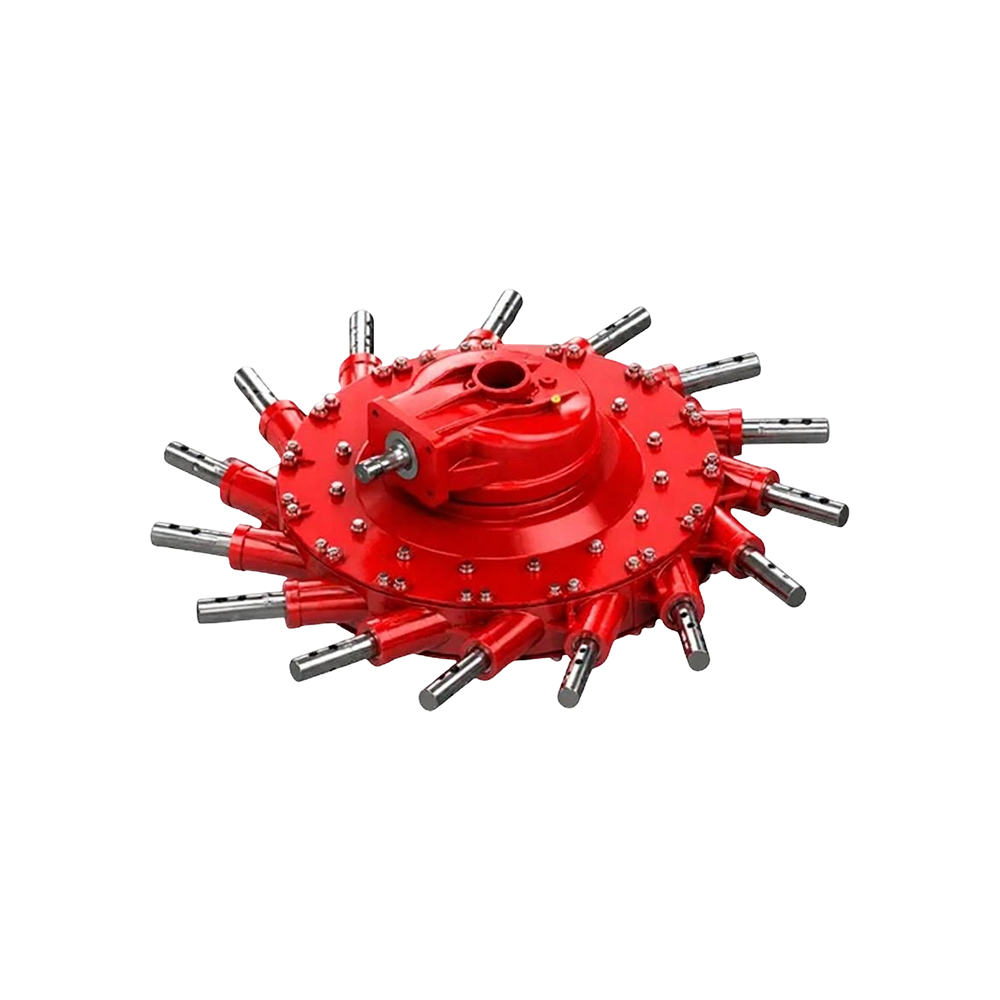 ND HR413 Fifteen-Output Heavy-Duty Rake GearboxHigh-spec fifteen-output power distributor for super-wide, heavy-duty raking machinery, with precision gearing, reinforced housing and independent lubrication for continuous high-load tasks.View Product →
Gear Timing: Why Output Shaft Phasing Matters
Multi-output rake gearboxes do not only transmit power, they also lock the relative angle of every rotor. Because the gear train is fixed, the arms on output one, two and three always sit at a known offset from each other. That offset is what allows tine paths to overlap without touching.
During a rebuild, the phasing is easy to disturb. Three things must be respected: the tooth indexing of the distribution gear pairs, the keyway or spline orientation on each output shaft, and the arm mounting marks on the rotor hubs. A shaft fitted one tooth out, or an arm bolted on the wrong spline, produces interference, wrapping and bent tines within minutes of start-up.
Before reconnecting the PTO after any repair, rotate the input by hand through two full turns. Every rotor should turn freely with no contact between tine groups, and the marks should return to their original alignment.
Load Path, Torque Split and Sizing
Torque split is even only in theory. In the field, one end of the rake often meets a heavier windrow, so the outputs nearest the input carry a stiffer load path through more of the cross shaft, while the far end works through greater torsional deflection. Good designs compensate with a stepped cross shaft, generous bearing spacing and a housing stiff enough to hold alignment under that uneven load.
Protection belongs upstream. A slip clutch or shear bolt on the PTO shaft protects the whole gear train from stone impact and start-up shock, and it is cheaper to replace than an output shaft. Ratio selection matters as well: the gearbox ratio must place tine tip speed in the range the crop needs, fast enough to lift hay cleanly and slow enough to avoid leaf loss in alfalfa.
Lubrication, Sealing and Daily Checks
Multi-output housings hold a larger oil volume than single-output units, and every extra seal is a potential leak point. A practical routine covers the following:
- Check the oil level at the level plug before the first job of the day, with the machine level.
- Drain and refill after the run-in period, then at the interval set by the manufacturer, using the specified gear oil grade.
- Inspect the breather; a blocked breather pushes oil past the output seals.
- Feel the housing after the first working pass. A hot spot near one bearing station points to preload or lubrication problems.
- Grease any externally lubricated bearings and check the PTO clutch or shear bolt for wear.
- Look for oil trails along the underside of the housing and around each output seal.
Choosing the Right Output Count for Your Rake
Output count should follow the machine, not the other way round. Work through these points before fixing a configuration:
- Working width and the number of rotors the rake will carry.
- Transport width limits on the road and between gates.
- Available PTO power and the intended tine tip speed.
- Crop type and yield, since heavy wet grass loads the tines far more than dry straw.
- Ground contour and the amount of flex the rotor suspension needs.
- Service access, because a long housing needs room for bearing maintenance.
Because rakes usually sit inside the wider hay and forage chain, it helps to review the complete harvest and material handling solutions picture before specifying a drive, so the gearbox matches the baler or loader that follows it.
HR Series Agricultural Rotary Rake GearboxesDedicated gearbox family for rotary rakes, offering multiple output-shaft counts and sealed, dustproof protection; selection depends on rotor count, spacing and working width.View Product →Frequently Asked Questions
Q1: Can a 6-output gearbox be used in place of a 15-output unit?
Only if the rake is redesigned around it. The output count is tied to the number of rotors and the working width, and the housing length and bearing layout follow from that. Substituting a shorter unit leaves rotor stations without a drive.
Q2: Why does the same rake model sometimes use different output counts?
Rake families often share a rotor design across several widths. A narrow version may use fewer output shafts from the same gear series, while the wide version uses the full row, with the same gear pitch and shaft size throughout.
Q3: What causes noise from a multi-output rake gearbox?
Common causes are worn output bearings, low oil level, a damaged seal allowing water in, incorrect backlash after a rebuild, or a phase error that loads the arms against each other. Noise that appears only when turning in one direction usually points to bearing or tooth damage.
Q4: Do output shafts need to be replaced as a set?
Not always, but the phase marks must be transferred carefully. If one shaft is replaced, check the keyway orientation against its neighbours and re-time the arms before the first run.
Working with a Gearbox Supplier on a Multi-Output Specification
Hengnie Machinery, based in the Xiaoshan industrial area of Hangzhou, builds agricultural gearboxes and transmission parts under its ND brand, including the HR series with configurations from one input to six, eight, nine, eleven, thirteen and fifteen outputs. Beyond catalogue models, the company develops gearboxes to customer requirements and produces gear, shaft and PTO components in house, which is useful when a rake design needs a non-standard output spacing or a specific ratio.
For a multi-output rake project, the practical starting point is a short specification: working width, rotor count, PTO power, target tine speed, mounting interface and transport limit. That is enough to narrow the configuration and confirm whether a standard housing fits or a custom layout is needed. To discuss a specification, contact the engineering team with the details of the rake and the tractor it will run behind.
Related Products

-
 +86 18058161630
-
 +86 571 81607235
-
 sales@ag-mech.cominfo@ag-mech.comiris@ag-mech.com
-
 No.21 Feixiang Rd, Suoqian Town,Xiaoshan Dist. Hangzhou, Zhejiang Province, China

Products

Contact Us
Copyright ©
Hangzhou Hengnie Machinery Co., Ltd.
All Rights Reserved. Wholesale Agriculture Speed Reducers Supplier Custom Agricultural Gearboxes Manufacturer

